

Many established organizations rely on legacy systems for support; however, over time, these systems become a hindrance to further growth, innovation, and increased efficiency. This is due to simply having outdated technology, significant support costs, and being unable to expand (or “scale”) due to limitations placed on those systems.
Therefore, modernizing legacy systems is required for many organizations; however, there is no universally applicable model for achieving this. The selection of the modernization approach will vary depending on business goals as well as the available budget and technological constraints.
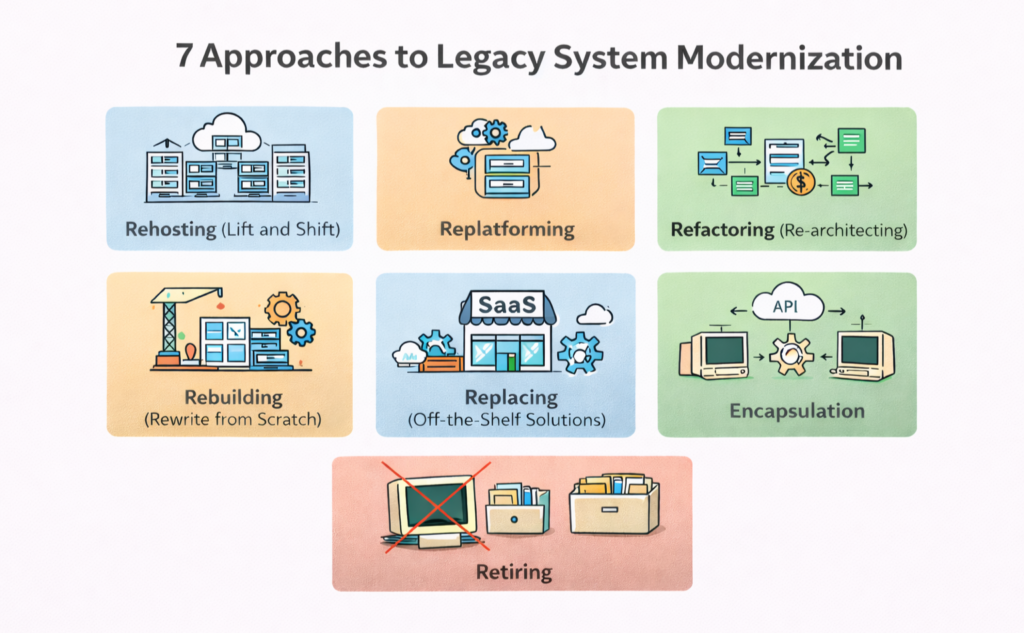
1. Rehosting (Lift and Shift)
Rehosting is the term used to describe the method of moving an existing application from an on-premises data centre to the cloud without making significant changes or updates to the application’s source code. As part of a broader legacy modernization service, rehosting typically provides the quickest and least disruptive form of application modernisation.
Many organisations will look to rehost due to a desire to reduce their infrastructure costs or improve the availability of their systems with little or no expense associated with re-developing the current application. Although rehosting does not resolve any architectural challenges within the application, it does provide a quick win, and establishes a basis for future improvements.
2. Replatforming
Replatforming is a type of migration in which minor improvements are made to make use of cloud technologies. For example, this could include moving to a managed database or using containers to run applications.
The basic building blocks remain the same, but the system will perform faster, be more scalable and easier to maintain than before the migration. Replatforming is ideal for those businesses that wish to experience benefits on an incremental basis without having to do a complete redesign of their systems.
3. Refactoring (Re-architecting)
Refactoring means changing and organizing your existing codebase so that performance, scalability and maintainability are improved. This may involve taking an application that exists as a single, monolithic application and splitting it up into smaller, independent applications known as microservices.
The development effort associated with refactoring is substantial, but the benefits will be long-term. As well as providing an easier way to work with newer technologies, refactoring enables continuous deployment of software and enhances the reliability or resiliency of your systems. Refactoring should be used when your systems are important to your business but may be suffering due to obsolescence of their present design.
4. Rebuilding (Rewrite from Scratch)
Rebuilding (re-create from scratch) a system means that you create an entirely new system and retain the core business logic of the existing application. It enables teams to leverage contemporary technologies and design principles while building without limitation of the previous systems’ constraints.
Rebuilding provides maximum ease and flexibility to future-proofing but comes with great time and resources. Risk will be higher when rebuilding an existing system if documentation for that system is lacking. Most often used when the existing system is beyond the ability to be salvaged.
5. Replacing (Off-the-Shelf Solutions)
There are times when it may be easier and cheaper to replace an older application with either a commercially available application (COTS) or a software-as-a-service (SaaS) solution. Two examples of this type of change would be switching from your current custom-developed CRM application to Salesforce or switching from an in-house-built ERP solution to SAP. Replacing an older application with any type of solution will remove your obligation for maintaining and developing that application, but there could be a significant impact to your business processes and possible vendor lock-in. Substituting older applications for standard solution types will work best when standard solutions can fulfill the majority of your business needs.
6. Encapsulation
This is the process of wrapping old systems with new, or modern, APIs to enable the old to work with new software/applications. It allows the old system to continue to provide a benefit while slowly converting the parts around it to new technology.
It is a low-risk method of integration into a new ecosystem (for example, a mobile app or the cloud).
Also, when there is interoperability between the old system and other systems (for example, between mobile apps, other software & the cloud), it is easier to integrate into those other systems with less downtime for the old system.
7. Retiring
Some legacy systems should just be “retired,” rather than needing to be upgraded. Companies can create clusters of irretrievable or unused applications over time, all of which can waste valuable resources.
The process of retiring a system involves finding those legacy systems that are no longer in use or in business since their inception and simply removing them from your organization. Retiring systems usually lowers overall complexity; reduces costs; and provides more time and energy to focus on higher-level, more useful, and more strategic initiatives than the systems that are retired. Retiring is often neglected, but a very successful modernization strategy.
Choosing the Right Approach
Selecting the right modernization strategy involves many factors, such as business goals, how complicated the system is, your financial resources, and how much risk you are willing to take. Organizations often implement a hybrid approach by taking different approaches for each of their systems.
For example, a company may want to rehost certain applications as an immediate return on investment while refactoring mission-critical applications to provide long-term scalability. Additionally, organizations will most likely choose to retire legacy tools. Therefore, performing a complete and detailed assessment of the current state of your IT environment is required prior to implementing any changes.
Concluding Remarks
Legacy System Modernisation is not just a technical upgrade; it is a strategic investment in the future of your business. The right technique will provide opportunities for innovation, efficiencies, and enhanced customer experiences. By identifying the seven ways to modernise an organisation can make well-informed choices about its approach to modernising its existing system.